

Many people get stuck between “invision” or “envision” while writing. Both words look and sound almost the same.
This confusion happens because English pronunciation can trick the eye. In this guide, you will learn the correct spelling, real meaning, and simple usage rules in plain English.
Envision Is the Correct Word
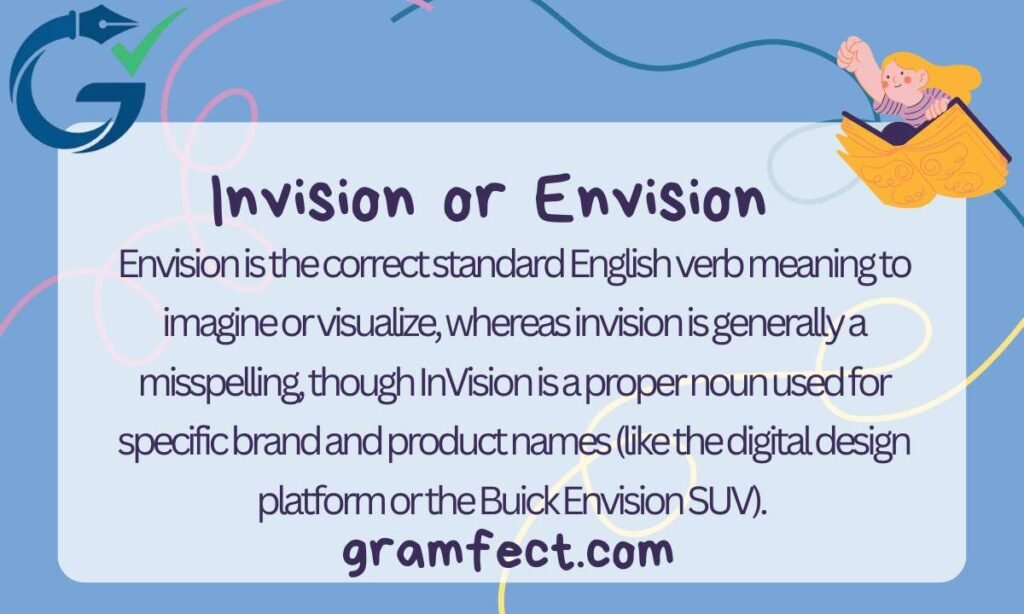
Envision is the only correct spelling. It means to imagine or picture something in your mind, usually about the future.
Quick Answer: Use “envision” every time you mean to imagine or visualize something. “Invision” is not a real word in standard English.
| Word | Correct? | Meaning |
| Envision | ✅ Yes | To imagine or picture a future event |
| Invision | ❌ No | Misspelling of “envision” |
| InVision | ✅ Yes (brand only) | A software company for design tools |
Why Invision Is Wrong
The confusion starts with sound. When you say “envision” fast, the first part sounds like “in.” That’s why people type “invision” by mistake.
English uses the prefix “en-” to turn words into action verbs, like enable, enrich, and encourage. The prefix “in-” usually means “not” or “inside,” as in invisible or inactive. Since “vision” needs the “en-” form to become a verb, the correct prefix for this word is “en-,” not “in-.”
So “invision” breaks basic English word-building rules. It simply does not exist as a dictionary word.
What Does Envision Mean and Usages
Envision Meaning
Envision means to see something in your mind before it happens. You use it when talking about goals, dreams, or future plans.
Envision Definition Synonym
The simple definition is “to picture something mentally.” Common synonyms include imagine, visualize, foresee, and picture.
Envision Word Origin
Envision comes from the prefix “en-” plus “vision,” which comes from the Latin word for sight. This makes the word literally mean to form a mental picture of something.
Envision or Envisage
Both words mean almost the same thing. Envision is more common in American English, while envisage is more common in British English.
Envision in Spanish
In Spanish, envision translates to “imaginar” or “visualizar,” depending on context. Both Spanish words carry the same “picture in your mind” meaning.
Envision vs Imagine
Envision usually connects to planning or a clear future goal. Imagine is broader and can include fantasy, memory, or anything unreal too.
InVision Software
InVision is a real design and prototyping company. Designers use InVision software to create app mockups and share projects with teams.
If you’re comparing similar tricky word pairs, this guide on whole day or all day breaks down another common English mix-up in the same easy style.
Synonyms of Envision
Here are common words you can use instead of envision:
- Imagine
- Visualize
- Foresee
- Picture
- Anticipate
- Predict
- Dream of
Why People Write Invision
There are three main reasons people misspell this word.
- Sound confusion – Envision sounds like it starts with “in.”
- Software influence – The brand InVision appears everywhere online.
- Prefix habit – Many “in-” words are common, so people copy that pattern.
None of these reasons make “invision” correct in writing.
How to Use Envision in a Sentence
Envision is a transitive verb, so it always needs an object after it. You envision something, not just envision alone.
Simple structure: Subject + envision + object (what you imagine)
Example: “She envisions a better future for her team.”
Envision Examples in Professional Writing
Professional writing often uses envision to describe goals and vision statements.
- “Our company envisions a fully remote work culture by 2027.”
- “The manager envisions faster delivery times next quarter.”
- “We envision stronger customer relationships through better service.”
Envision Examples in Everyday Conversation
You can also use envision in casual, daily talk.
- “I envision us traveling together next summer.”
- “Can you envision living in a smaller house?”
- “He envisions a quiet weekend at home.”
Envision in Business and Academic Writing
Business plans and academic papers use envision to describe long-term goals or research outcomes.
| Writing Type | Example Sentence |
| Business plan | “We envision expanding into three new markets.” |
| Academic paper | “Researchers envision new treatment methods.” |
| Vision statement | “We envision a world with cleaner energy.” |
Envision sounds confident and forward-looking. This is why it fits well in formal documents.
Frequently Asked Questions
Is it “envision” or “invision”?
Envision is correct. Invision is a misspelling with no dictionary meaning.
Is invision a real English word?
No. Invision does not exist in any standard English dictionary.
What does InVision mean then?
InVision (capitalized) is the name of a design and prototyping software company.
Can I use invision in formal writing?
No. Always use envision in essays, emails, and business documents.
Is envision the same as envisage?
They mean almost the same thing. Envisage is more common in British English.
What is a simple synonym for envision?
Imagine or visualize are the easiest synonyms to use instead.
Does British English use invision too?
No. British English also uses envision, not invision, in all cases.
Conclusion
Envision is the only correct spelling when you mean to imagine or picture something. Invision has no real meaning and should never appear in your writing, except as part of the brand name InVision.
Remember the simple rule: envision for imagination, InVision for the software company. Once you understand this small difference, you’ll never confuse these words again. For a deeper look at English word roots, check Merriam-Webster’s dictionary for more examples and definitions.

Hi, I’m Lily, a grammar lover with 5+ years of experience in English writing and editing. I enjoy making grammar simple, clear, and easy to understand for everyone.


1 thought on “Invision or Envision – Which Is Correct? (2026 Guide)”