

Have you ever typed “brite” instead of “bright” and wondered if it was even a real word? You are not alone.
This mix-up happens a lot in texting, branding, and casual writing. Below, you’ll get a simple, clear answer, backed by dictionary rules and real examples.
Quick Answer: Is It “Brite” or “Bright”?
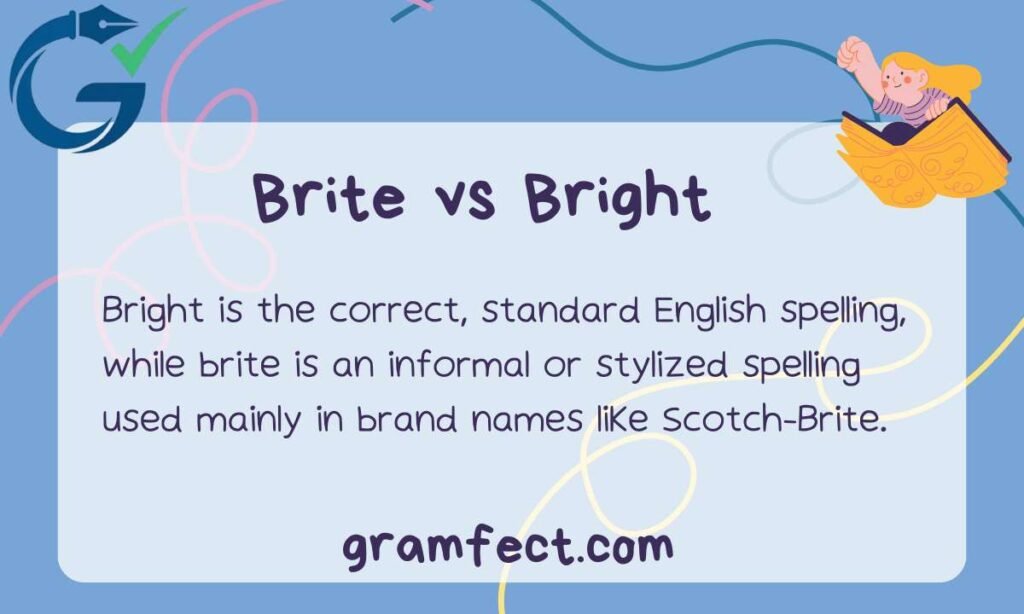
Bright is the correct, standard English word. It means full of light, vivid, or intelligent.
Brite is not standard English. It shows up mainly in brand names, marketing, and informal texting, and it also has one narrow technical meaning in brewing.
| Word | Standard Word? | Common Use | Part of Speech |
| Bright | Yes | Everyday writing, speech, school, business | Adjective |
| Brite | No (mostly) | Brand names, ads, texting, brewing term | Informal / niche |
If you’re writing anything formal, always choose bright.
This confusion usually starts with autocorrect, brand names, or fast texting habits. Once you see the pattern, it’s easy to remember which spelling fits which situation.
What Does Bright Mean?
Bright is an adjective that describes strong light, vivid color, or sharp intelligence. It’s one of the most common descriptive words in English.
Dictionaries define bright in three main ways:
- Giving off or reflecting a lot of light
- Vivid or strong in color
- Clever, quick-thinking, or intelligent
For example, “The sun was bright this morning” describes light. “She gave a bright smile” describes warmth and energy. “He’s a bright student” describes intelligence.
Using Bright in Everyday American English
Native speakers use bright constantly, in speech and writing. It appears in weather reports, school report cards, and everyday conversation.
Here are common natural examples:
- “Turn on the bright light in the kitchen.”
- “That’s a bright idea, let’s try it.”
- “The kids wore bright yellow jackets.”
- “She has a bright future ahead.”
Notice how bright works for light, color, and intelligence, all in the same word. That flexibility is why it’s used so often.
Teachers, writers, and news anchors all rely on bright because it’s clear and instantly understood. There’s no confusion, no second meaning to explain, and no risk of sounding unprofessional. That’s a big reason it stays a top choice in both spoken and written English.
What Is the Meaning of Brite?
Brite does have one real, technical meaning. In brewing, “brite” refers to a stage where beer sits in a brite tank before it’s packaged.
A brite tank is used to clarify and carbonate beer after fermentation. Brewers sometimes call this the “brite” stage of the process.
Outside brewing, brite is mostly used as a stylized spelling of bright. You’ll see it in brand names, product labels, and quick text messages, but not in formal or academic writing.
Some regional and older dictionaries also list “brite” as a rare, dialect form meaning “to become overripe,” used for wheat, barley, or hops. This meaning is uncommon today and mostly appears in historical or brewing references, not modern conversation.
Where Does “Bright” Come From? (Origin & Etymology)
Bright comes from the Old English word beorht, meaning shining or radiant. This word has Germanic roots and appears in similar forms across older Germanic languages.
Over centuries, beorht shifted in spelling and pronunciation until it became the modern word bright. The core meaning, shining or full of light, has barely changed at all.
This long history is one reason bright is considered a fully standard, dictionary-approved word. Brite has no such history. It’s a modern, informal shortcut, not an evolved form of an older word.
Linguists often point out that words with strong historical roots, like bright, tend to stay stable in spelling. Newer stylized spellings, like brite, usually stay limited to branding and pop culture instead of replacing the original word.
Is “Brite” a Real Word? (Dictionary & Scrabble Rules)
This is the question most people actually want answered. Here’s the short version.
Major dictionaries do not list “brite” as a standard headword with the same meaning as bright. It’s treated as informal or as a stylized spelling used in marketing.
For word games, the rules are strict:
| Game | Is “Brite” Allowed? |
| Official Scrabble (NASPA/TWL) | No |
| Collins Scrabble Words (CSW) | No |
| Words With Friends | No |
| Casual texting or ads | Yes, informally |
So if you’re playing Scrabble, don’t try to play “brite.” It won’t count, no matter how confident you feel.
When Is “Brite” Acceptable? (Brand Names, Marketing & Texting)
“Brite” isn’t wrong everywhere. It just belongs in specific, informal spaces, not in essays, emails, or reports.
It’s commonly acceptable in these situations:
- Brand and product names – companies use it to look catchy and modern
- Marketing slogans – short, punchy spelling grabs attention
- Texting and social media – informal spelling saves space and feels casual
- Brewing industry terms – “brite tank” is an actual technical term
Outside these cases, stick with the standard spelling: bright.
“Brite” in Brand Names (Lite-Brite and Others)
Brands love shortened, stylized spellings because they stand out and feel fun. This is exactly why “brite” shows up so often in product names.
Some well-known examples include:
- Lite-Brite – the classic light-up toy
- Rainbow Brite – a popular children’s cartoon character
- Various teeth-whitening and cleaning product names
These names work because they’re memorable and easy to trademark. They are not meant to teach correct spelling, they’re meant to sell products.
Marketing teams often test shortened spellings because they feel fresh and modern. A name like “Brite” catches the eye faster than “Bright” in a crowded store aisle or online ad. This is a design choice, not a grammar rule, so it shouldn’t guide your everyday writing.
What Do AP Style and Chicago Manual of Style Say?
Both major style guides agree on this point: use bright, not brite, in professional and published writing.
AP Style follows standard dictionary spelling for everyday words like bright. It does not recognize “brite” as an approved alternative spelling.
The Chicago Manual of Style takes the same position. Standard, dictionary-based spelling is expected in books, articles, and formal documents. Brand names are the only real exception, since trademarks keep their original stylized spelling.
If you’re a writer, student, or content creator, this rule is simple: always write bright in formal content.
Common Mistakes: “Brite” vs “Bright” (Wrong vs Correct Examples)
Here’s a quick table to fix the most common errors people make with these two words.
| Wrong | Correct | Why |
| The room is very brite. | The room is very bright. | Brite is not standard for describing light |
| She’s a brite student. | She’s a bright student. | Bright describes intelligence |
| brite idea | bright idea | Common phrase uses bright, not brite |
| Brite colors suit you. | Bright colors suit you. | Bright is correct for describing color |
A simple rule to remember: unless you’re naming a brand or referring to a brewing tank, always spell it bright.
By the way, mixing up similar-looking words isn’t limited to spelling. English speakers often confuse phrasing too, like when to use “when I can” versus “when can I” in a sentence. If that trips you up, this guide on when I can or when can I breaks it down clearly.
How to Pronounce “Brite” vs “Bright”
Here’s something interesting: both words are pronounced exactly the same way. They are homophones.
Both are said as “brahyt”, rhyming with “kite” or “night.” The spelling changes, but the sound does not.
This is actually why so many people mix them up in texting and quick writing. Since they sound identical, the brain sometimes defaults to the shorter, simpler spelling, brite, especially when typing fast.
FAQs About Brite vs Bright
Is “brite” a misspelling of “bright”?
In most everyday contexts, yes. Standard dictionaries treat brite as informal, not as correct spelling.
Can I use “brite” in school or business writing?
No. Always use bright in formal, academic, or professional writing.
Why do brands use “brite” instead of “bright”?
Brands use it because it looks catchy, modern, and easier to trademark than a common dictionary word.
Is “brite” a valid word in Scrabble?
No. Brite is not accepted in official Scrabble or Words With Friends dictionaries.
Do “brite” and “bright” sound different?
No, they sound identical. Both are pronounced the same way, like “kite” with a “b” and “r” sound.
What does “brite” mean in brewing?
It refers to the brite tank stage, where beer is clarified and carbonated before packaging.
Which spelling should I always use in writing?
Use bright. It’s the dictionary-correct, universally accepted spelling for all standard writing.
Conclusion
Bright is the correct word for everyday writing, speech, and formal content. It has deep roots in English and covers light, color, and intelligence in one simple word.
Brite, on the other hand, belongs to brand names, casual texting, and one specific brewing term. Once you know this difference, you’ll never second-guess your spelling again. For deeper grammar rules on English spelling standards, resources like Merriam-Webster remain a trusted, authoritative reference.

Hi, I’m Lily, a grammar lover with 5+ years of experience in English writing and editing. I enjoy making grammar simple, clear, and easy to understand for everyone.