

Have you ever paused mid-sentence, unsure if it’s “she has” or “she have”? You’re not alone. This tiny grammar mix-up trips up even confident English speakers.
The good news is the rule is simple once you see it clearly. This guide breaks it down with easy examples, quick answers, and a handy quiz section, so you never second-guess it again.
The Quick Answer: She Has vs. She Have
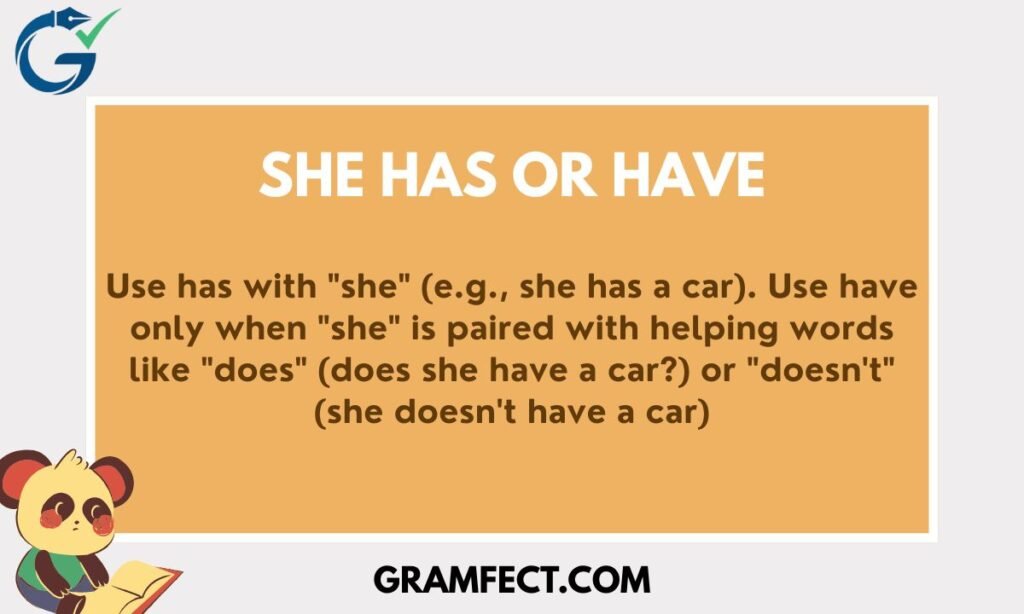
“She has” is always correct. “She have” is always wrong.
This is because “she” is a singular subject, and singular subjects need the verb “has,” not “have.”
| Subject | Correct Verb | Example |
| She | has | She has a new phone. |
| He | has | He has two dogs. |
| It | has | It has four wheels. |
| They | have | They have a big house. |
| We | have | We have plenty of time. |
Simple rule to remember: she, he, it → has. I, you, we, they → have.
She Has or Have Meaning
“Has” and “have” are both forms of the verb “to have.” This verb shows ownership, possession, or a state of being.
The meaning doesn’t change between the two words. Only the form changes, depending on the subject in the sentence.
So “she has a car” and “they have a car” mean the same thing: ownership. The verb just adjusts to match the subject.
She Has or Have or Had
“Has” and “have” are present tense. “Had” is past tense, and it works the same way for every subject.
| Tense | Singular (she/he/it) | Plural (I/you/we/they) |
| Present | has | have |
| Past | had | had |
Notice something important: “had” doesn’t change based on the subject. That makes past tense much easier than present tense.
Example: “She has a meeting today” becomes “She had a meeting yesterday.” The subject stays the same, but the verb shifts with time.
She Has or Have Synonym
Sometimes “has” and “have” can be swapped for other words, depending on the sentence’s meaning.
Common synonyms include:
- Owns – She owns a car. (She has a car.)
- Possesses – She possesses great skill. (She has great skill.)
- Holds – She holds a degree. (She has a degree.)
- Experiences – She has a headache. (She experiences a headache.)
These synonyms work well in formal writing when you want to avoid repeating “has” too often in one paragraph.
They Has or Have
This one flips the rule. “They” is a plural subject, so it always pairs with “have,” never “has.”
Correct: They have a new apartment. Incorrect: They has a new apartment.
This confuses many learners because “has” sounds close to “have,” but plural subjects strictly require “have” in every case.
She Has or Have Quiz
Test yourself with these quick questions. Try to answer before checking below.
- She ___ a beautiful garden.
- They ___ three cats.
- He ___ finished his homework.
- We ___ a meeting at noon.
- It ___ been raining all day.
Answers: 1. has, 2. have, 3. has, 4. have, 5. has
If you got all five right, you’ve already mastered the core rule behind this guide.
She Has or Have in a Sentence
Seeing the rule inside full sentences makes it stick faster than memorizing definitions alone.
- She has a strong work ethic.
- She has been working here for five years.
- Does she have any siblings?
- She doesn’t have time today.
Notice that in questions and negative sentences, “have” can appear even with “she.” That’s because the helping verb “does” already carries the singular agreement. We’ll cover this exception in detail below.
She Has or Have Many Friends
A common real-world example is “she has many friends” versus the incorrect “she have many friends.”
Correct: She has many friends who support her. Incorrect: She have many friends who support her.
This example shows exactly why the subject-verb rule matters. One small word choice changes whether a sentence sounds correct or careless.
She Has or Have Examples
Here are more real, everyday examples to build confidence using “has” correctly with “she.”
| Sentence | Correct Form |
| She ___ a great idea. | has |
| She ___ two brothers. | has |
| She ___ already eaten lunch. | has |
| She ___ never been to Paris. | has |
| She ___ a lot of patience. | has |
Every single example follows the same pattern: singular subject, so “has” is the only correct choice in a simple present sentence.
Has vs Have – Subject Verb Agreement
This whole topic comes down to one grammar concept: subject-verb agreement. The verb must always match the subject in number.
Featured snippet answer: Subject-verb agreement means the verb form must match whether the subject is singular or plural. Singular subjects like “she,” “he,” and “it” use “has.” Plural subjects like “they,” “we,” and “you” use “have.”
Grammar experts and style guides, including Grammarly’s guide on subject-verb agreement, confirm this same standard rule across formal and casual English writing.
Why “She Has” Is Always Correct (Understanding Subject-Verb Agreement)
English verbs change slightly based on the subject. This is called conjugation, and “have” is one of the most irregular verbs in English.
In the present tense, “have” only becomes “has” with third-person singular subjects: he, she, and it. Every other subject keeps the base form “have.”
This is different from most verbs, which simply add “-s” for third-person singular, like “walk” becoming “walks.” “Have” instead transforms into a completely different word: “has.”
That irregular shift is exactly why so many people mix it up. Once you remember this one exception, the rest becomes automatic.
She Has vs. She Have in Different Tenses and Forms
The rule changes slightly depending on tense and sentence structure. Here’s a full breakdown to avoid confusion.
Present Simple Tense
In present simple, “she has” is correct. “She have” is never correct in a plain statement.
- Correct: She has a dog.
- Incorrect: She have a dog.
Present Perfect Tense
Present perfect uses “has” plus a past participle for singular subjects like “she.”
- Correct: She has finished her project.
- Incorrect: She have finished her project.
Questions with “Does”
When forming questions, “does” carries the singular agreement, so the main verb returns to “have.”
- Correct: Does she have a pet?
- Incorrect: Does she has a pet?
Negative Sentences with “Doesn’t”
Similarly, “doesn’t” already shows singular agreement, so “have” follows it instead of “has.”
- Correct: She doesn’t have time.
- Incorrect: She doesn’t has time.
Quick Reference Table
| Sentence Type | Correct Form | Example |
| Simple statement | has | She has a laptop. |
| Perfect tense | has | She has traveled abroad. |
| Question with “does” | have | Does she have a laptop? |
| Negative with “doesn’t” | have | She doesn’t have a laptop. |
| Past tense | had | She had a laptop. |
This table covers almost every situation you’ll run into with “she has” or “she have” in daily writing and speaking. Once you know these five patterns, this specific grammar mistake becomes very easy to avoid, similar to how mastering casual slang, like this breakdown of Opps meaning, helps you sound natural and confident with everyday language too.
For Frequently Asked Questions
Is it correct to say “she has” or “she have”?
“She has” is always correct in simple present statements. “She have” is grammatically incorrect.
When do we use “have” with “she”?
“Have” is used with “she” only after helping verbs like “does” or “doesn’t,” such as “Does she have time?”
Why is “has” used instead of “have” for she, he, and it?
Because “have” is an irregular verb, and third-person singular subjects require the special form “has.”
Is “she have” ever grammatically correct?
No, “she have” is never correct on its own in a standard present tense sentence.
What is the past tense of “she has”?
The past tense is “she had.” It stays the same for every subject in past tense.
How do I remember when to use “has” or “have”?
Just remember: she, he, it use “has.” I, you, we, they use “have.” It’s a simple two-group rule.
Does “they has” or “they have” is correct?
“They have” is correct. “They” is plural, so it always pairs with “have,” never “has.”
Conclusion
“She has” is the correct form in nearly every simple sentence you’ll write or speak. “She have” only feels tempting because “have” sounds familiar, but it breaks basic subject-verb agreement.
Once you remember that singular subjects like she, he, and it always pair with “has,” this mistake disappears for good. Questions and negative sentences are the only exception worth remembering.
Grammar rules like this one seem small, but they shape how clear and confident your writing sounds. For deeper grammar guidance, trusted sources like the Purdue Online Writing Lab offer reliable, well-tested rules worth bookmarking.

Hi, I’m Lily, a grammar lover with 5+ years of experience in English writing and editing. I enjoy making grammar simple, clear, and easy to understand for everyone.


1 thought on “She Has or Have – Which Is Correct? Complete Grammar Guide (2026)”