

Have you ever paused while writing and wondered if it should be “by which” or “in which”? You’re not alone. Even confident English speakers mix these two up.
The good news is that the rule is simple once you see it clearly. This guide breaks down the difference in plain English, with examples, a comparison table, and a quick quiz so you never confuse them again.
Quick Answer: “By Which” or “In Which”?
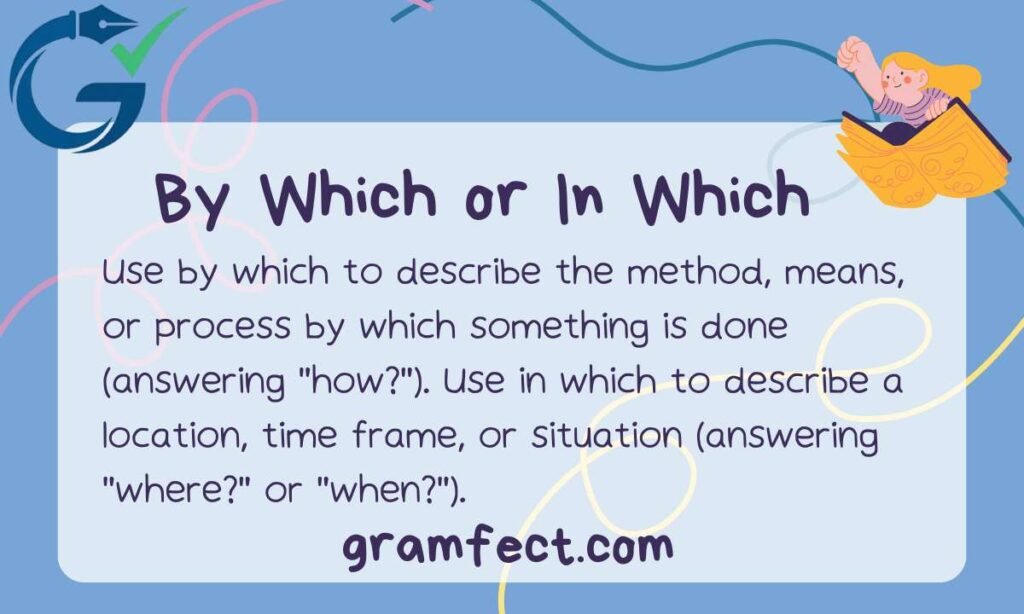
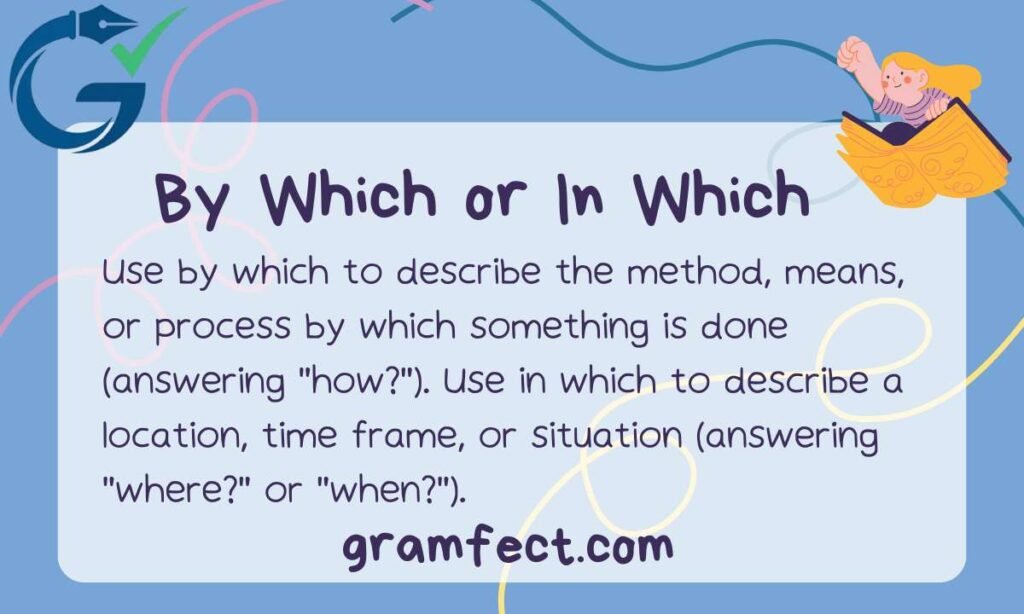
“By which” and “in which” are both correct, but they mean different things.
- By which = the method or way something happens (how)
- In which = the place, time, or situation something happens (where or when)
Example: “The process by which water becomes ice is called freezing.” Here, “by which” explains how freezing happens.
Example: “The lab in which the experiment took place was closed.” Here, “in which” tells us where it happened.
By Which vs In Which: What’s the Real Difference? (How vs Where)
Both phrases connect a noun to extra information using “which.” But the small word before “which” changes everything.
Think of it like this: “by” points to a tool or method. “in” points to a container or setting.
- Use by when you can replace it with “through” or “using.”
- Use in when you can replace it with “where” or “inside.”
This simple test works almost every time. If your sentence explains a process, go with “by which.” If it points to a location, time, or scenario, go with “in which.”
When to Use “By Which” (Rules + Examples)
Use “by which” when the sentence describes a method, tool, or process. It answers the question “how?”
Rules to remember:
- The main verb often pairs naturally with “by” (achieved by, solved by, measured by)
- It usually follows nouns like method, process, system, means, or way
- It sounds formal, so it fits reports, essays, and business writing
Examples:
- The method by which the team solved the issue was smart and fast.
- Voting is the process by which citizens choose their leaders.
- She explained the way by which the machine sorts items.
- This is the system by which orders get tracked.
When to Use “In Which” (Rules + Examples)
Use “in which” when the sentence describes a place, time, or condition. It answers the question “where?” or “in what situation?”
Rules to remember:
- The verb often pairs naturally with “in” (lived in, happened in, found in)
- It follows nouns like room, city, era, situation, case, or world
- It’s the more common phrase of the two in everyday English
Examples:
- This is the house in which she grew up.
- The era in which he lived was full of change.
- That’s the case in which the rule doesn’t apply.
- The classroom in which we studied was small.
By Which vs In Which at a Glance (Comparison Table)
| Feature | By Which | In Which |
|---|---|---|
| Meaning | Method or way (how) | Place, time, or situation (where/when) |
| Common pairing | Achieved by, caused by, done by | Lived in, found in, happened in |
| Typical nouns | Method, process, system, means | Room, city, era, case, world |
| Question it answers | How? | Where? or In what? |
| Formality | Formal, often legal or academic | Common in both formal and casual writing |
| Example | The way by which he escaped was clever. | The town in which he was born is small. |
Matching the Preposition to the Verb (Why “By” or “In” Isn’t Random)
Here’s a trick that top writers use: test the sentence without “which.”
Ask yourself, does the verb naturally use “by” or “in”? For example, we say “caused by,” not “caused in.” So you’d write “the reason by which this happened.”
We also say “occurred in,” not “occurred by.” So you’d write “the year in which it occurred.”
This small check removes almost all guesswork. Your verb decides the preposition, not personal preference.
“By Which Time” — A Special Case
“By which time” is a fixed phrase used to talk about a deadline or point in time. It means “before that time” or “at that point.”
Example: “The meeting starts at 9 AM, by which time everyone should be seated.”
Here, “by which time” shows a limit. It’s different from plain “by which,” which usually explains a method, not a time limit. Think of it as its own special expression worth memorizing.
“Whereby,” “Through Which,” and “Wherein” — Related Phrases Explained
A few close cousins often confuse learners too. Here’s a fast breakdown:
- Whereby = a formal, one-word version of “by which.” Example: “They signed an agreement whereby both sides share the profit.”
- Through which = very close to “by which,” often used for a passage, channel, or process. Example: “The tunnel through which the train passes is old.”
- Wherein = a formal version of “in which,” mostly used in legal or old-fashioned writing. Example: “This is the clause wherein the terms are listed.”
You don’t need to use these often, but recognizing them helps you read formal English with ease. If you also get confused between similar time-based phrases, this guide on when I can or when can I clears up another common mix-up in everyday grammar.
Common Mistakes (Wrong vs Correct Examples)
Small preposition slips are easy to make. Here’s a quick table to fix the most common ones.
| Wrong | Correct | Why |
|---|---|---|
| The way in which he fixed it | The way by which he fixed it | “Way” pairs with method, so use “by” |
| The city by which she was born | The city in which she was born | Birthplace is a location, use “in” |
| The method in which it works | The method by which it works | “Method” needs “by” for process |
| The room by which we met | The room in which we met | “Room” is a place, use “in” |
“Manner in Which” or “Manner by Which”?
“Manner in which” is the correct and standard phrase. Even though “manner” seems close to “method,” English treats “manner” as a style or situation, not a tool.
Example: “I didn’t like the manner in which he spoke to me.”
You will rarely see “manner by which” in modern, natural English. Stick with “in” here.
“Method in Which” or “Method by Which”?
“Method by which” is correct. “Method” clearly means a process or technique, so it pairs with “by,” not “in.”
Example: “The method by which the vaccine was developed took years.”
If you remember only one rule from this article, remember this: method goes with “by,” and manner goes with “in.” That single fact solves most confusion instantly.
Common Expressions and Idioms Using “By Which” and “In Which”
Both phrases show up often in fixed expressions. Knowing them makes your writing sound more natural and native-like.
Expressions with “By Which”
- The means by which
- The process by which
- The mechanism by which
- The rate by which (also seen as “at which”)
- The standard by which
Expressions with “In Which”
- The world in which we live
- The situation in which
- The context in which
- The environment in which
- The way in which (note: uses “in,” not “by”)
Quick Practice Quiz: Test Yourself
Fill in the blank with “by which” or “in which”:
- This is the town ___ I was raised.
- The process ___ plants make food is called photosynthesis.
- That’s the situation ___ we found ourselves stuck.
- The method ___ she solved the puzzle was clever.
Answers: 1. in which, 2. by which, 3. in which, 4. by which
FAQs About “By Which” and “In Which”
Is “by which” grammatically correct?
Yes. “By which” is fully correct when describing a method, process, or means of doing something.
Is “in which” formal or casual?
“In which” works in both formal and casual English, making it more flexible than “by which.”
Can I use “which” alone instead of these phrases?
Sometimes, but adding “by” or “in” gives your sentence more precise meaning and sounds more polished.
What is the difference between “whereby” and “by which”?
“Whereby” is a shorter, more formal one-word version of “by which.” Both mean the same thing.
Is “the way in which” correct English?
Yes. “The way in which” is a common, correct phrase used to describe how something is done, despite “way” sounding like a method.
Can “by which” and “in which” ever be interchangeable?
Rarely. The correct choice depends on the main verb in your sentence, not personal style.
Which phrase is used more often in everyday English?
“In which” appears more often because situations, places, and time references come up more than technical processes.
Conclusion
Choosing between “by which” and “in which” comes down to one simple question. Are you explaining how something happens, or where and when it happens?
Once that question becomes second nature, your writing gets clearer and more professional instantly. Keep this guide handy, and check the verb in your sentence whenever you feel unsure. For a deeper look at English preposition rules, the Merriam-Webster grammar guide is a trusted resource worth bookmarking.

Hi, I’m Lily, a grammar lover with 5+ years of experience in English writing and editing. I enjoy making grammar simple, clear, and easy to understand for everyone.